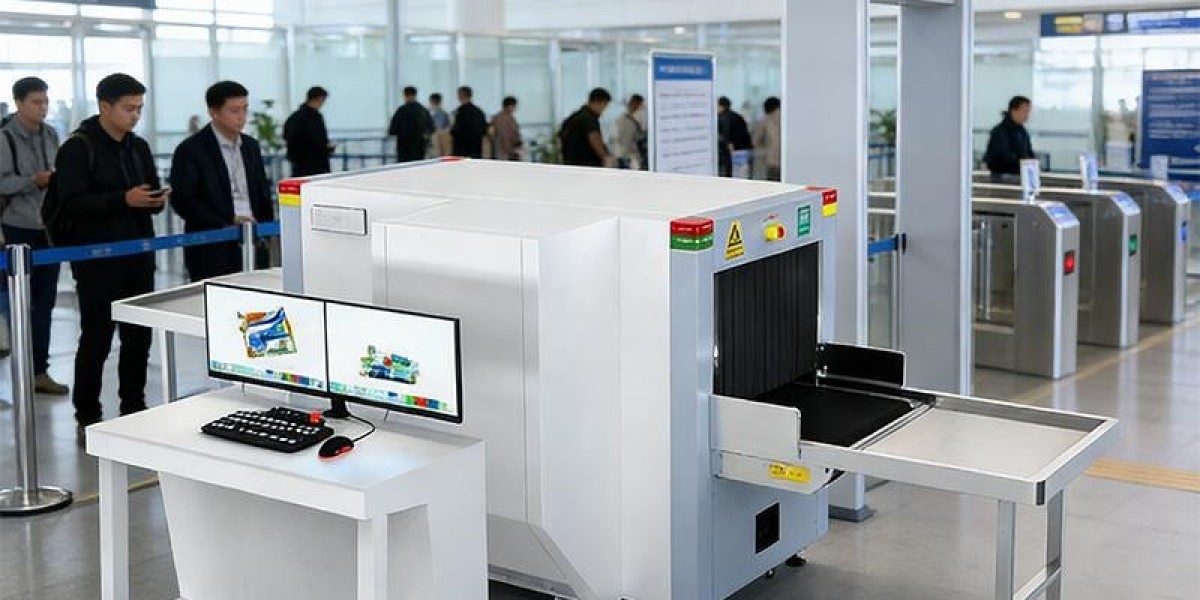

Airport security is an essential part of modern transportation infrastructure. With millions of passengers travelling every day, airports need reliable inspection equipment and well-organised screening procedures to help protect passengers, employees, aircraft, and airport facilities.
From baggage inspection to passenger screening, different security technologies work together to identify potential threats and support safe airport operations. Selecting the right equipment is therefore an important responsibility for airport authorities, security agencies, infrastructure developers, and procurement professionals.
Modern airport security screening systems combine X-ray baggage inspection machines, metal detection equipment, explosive detection technologies, and other security solutions. In India, equipment selection must also consider applicable Ministry of Home Affairs (MHA) requirements and Bureau of Civil Aviation Security (BCAS) guidelines.
Understanding these technologies and their applications can help organisations make informed decisions when planning new installations or upgrading existing airport security infrastructure.
What Are Airport Security Screening Systems?
Airport security screening systems are specialised technologies used to inspect passengers, baggage, parcels, and other items entering controlled airport areas.
Their purpose is to help identify prohibited articles, suspicious objects, and potential security threats before they reach restricted areas or aircraft.
A comprehensive airport screening arrangement may include:
X-ray baggage inspection systems
Dual-view X-ray baggage scanners
Computed tomography (CT) screening systems
Door-frame metal detectors
Hand-held metal detectors
Explosive trace detection equipment
Vehicle and cargo inspection systems
Access-control and security monitoring technologies
Each technology serves a different purpose. The combination selected depends on airport size, passenger volume, screening requirements, regulatory conditions, and the security procedures followed by the facility.
Why Modern Airports Need Advanced Security Screening Equipment
Airports operate in complex environments where passenger movement, baggage handling, and aircraft operations must function efficiently.
Security equipment must support inspection requirements without unnecessarily disrupting airport operations.
1. Baggage inspection
X-ray scanners allow security personnel to examine baggage contents without routinely opening every bag. Operators review the resulting images to identify suspicious items and determine whether additional inspection is necessary.
2. Passenger safety
Metal detection and other approved passenger-screening technologies help security personnel identify prohibited objects according to applicable procedures.
3. Efficient airport operations
Suitable screening equipment, combined with effective staffing and baggage-handling procedures, can support smoother passenger and baggage movement.
4. Multiple inspection requirements
Airports handle cabin baggage, checked baggage, oversized luggage, parcels, and cargo. Different inspection applications require different equipment configurations.
5. Regulatory compliance
Airport security equipment must be selected and operated in accordance with the applicable aviation-security requirements, technical specifications, and safety obligations.
Understanding MHA Approved Baggage Scanners
When evaluating security equipment in India, buyers frequently search for MHA approved baggage scanners.
The Ministry of Home Affairs plays an important role in India's internal security framework and oversees various security-related policies and organisations.
However, buyers should distinguish between a product being manufactured by an established security company and a specific model being accepted or approved for a particular procurement or security application.
Before purchasing an X-ray baggage scanner, organisations should review the applicable procurement requirements and confirm the following:
Technical specifications
Check the scanner's tunnel dimensions, conveyor speed, X-ray generator specifications, image resolution, penetration capability, and other parameters required by the relevant tender.
Radiation safety documentation
Verify applicable Atomic Energy Regulatory Board (AERB) requirements and the documentation required for the equipment's installation and operation.
Manufacturer credentials
Review the manufacturer's experience, product documentation, installation capabilities, service network, and relevant certifications.
Tender and procurement conditions
Government departments and security organisations may specify particular technical standards, documentation, and eligibility conditions. The quoted equipment must satisfy the requirements of the specific procurement.
Model-specific verification
Do not assume that a manufacturer's entire product range has the same approval status. Confirm the exact model and configuration against the relevant official documentation.
Organisations can explore Krystalvision's MHA-related and BCAS baggage scanner product category when researching suitable inspection equipment.
What Are BCAS Approved Baggage Scanners?
The Bureau of Civil Aviation Security (BCAS) is India's aviation-security regulator. It establishes and oversees aviation-security requirements and procedures for the Indian civil aviation sector.
The term BCAS approved baggage scanners is commonly used by buyers searching for baggage inspection systems suitable for airport security applications.
However, regulatory acceptance and equipment suitability must be established using the applicable BCAS requirements and the exact equipment documentation.
A scanner should not be described as BCAS approved merely because it is advertised for airport use.
Important factors to verify
1. Applicable BCAS requirements
Confirm the security requirements relevant to the airport, checkpoint, baggage category, and intended use.
2. Equipment configuration
Verify the precise scanner model, imaging configuration, software version where relevant, and any other specified equipment details.
3. Technical documentation
Review product specifications, safety documentation, testing information, and certificates requested by the procurement authority.
4. Installation and operational suitability
Ensure that the proposed system meets the installation, baggage-handling, maintenance, and operational requirements.
5. Current regulatory status
Check the latest applicable official requirements rather than relying exclusively on old advertisements, supplier claims, or third-party listings.
This verification process helps buyers avoid confusing general product capabilities with formal regulatory acceptance.
Types of X-Ray Baggage Scanners Used in Airport Security
X-ray inspection systems are among the most widely used technologies in baggage-screening environments.
Different scanner configurations are designed for different baggage sizes and inspection requirements.
1. Small-size X-ray baggage scanners
Compact baggage scanners are suitable for applications involving smaller bags and personal belongings.
They may be used at selected building entrances, smaller security checkpoints, and other controlled-access locations.
2. Dual-view X-ray baggage scanners
Dual-view systems generate images from two different directions, typically horizontal and vertical.
This provides complementary information that can help operators examine overlapping objects within baggage.
They can be useful where additional viewing perspectives are required for image interpretation.
3. Large baggage inspection systems
Large-format scanners are designed for oversized suitcases, registered baggage, and other items that require larger inspection tunnels.
Their suitability depends on tunnel dimensions, conveyor load capacity, imaging performance, and the intended application.
4. CT-based baggage inspection systems
Computed tomography (CT) systems use measurements collected from multiple angles to reconstruct volumetric information about baggage contents.
These systems offer different imaging capabilities from conventional single-view or dual-view X-ray scanners.
Airport procurement teams should check the specific CT technology, applicable certification, and regulatory requirements before selecting a system.
5. Cargo and pallet inspection systems
Cargo inspection equipment is designed for larger and potentially denser objects.
The system must be selected according to the dimensions, weight, material characteristics, and throughput requirements of the cargo operation.
Key Features to Consider When Selecting Airport Security Screening Systems
Choosing the right equipment requires an evaluation of technical performance and long-term operational requirements.
Image quality and inspection capability
The scanner should provide suitable image quality for the intended screening application. Buyers should assess image resolution, material differentiation features where available, penetration performance, and image consistency.
Tunnel dimensions
The inspection tunnel must accommodate the size of the baggage being screened.
A small checkpoint scanner may not be appropriate for large suitcases or oversized parcels.
Conveyor performance
Conveyor speed, loading height, belt width, and permitted baggage weight can affect the screening process.
Operator workstation
The operator interface should allow security personnel to review images effectively and use the available inspection tools.
Software capabilities
Some systems provide image enhancement, automatic threat highlighting, networking, or AI-assisted analysis. Buyers should confirm which functions are included in the proposed configuration.
Maintenance and after-sales support
Long-term equipment reliability depends on maintenance planning, technical assistance, spare-parts availability, software support, and operator training.
The Role of Artificial Intelligence in Airport Security Screening
Artificial intelligence is becoming an important area of development in security inspection technology.
AI-based image-analysis software can examine X-ray images and identify patterns associated with specified threat categories.
Depending on the system, the software may highlight suspicious objects, generate alerts, or help operators prioritise particular areas of an image.
Potential applications include:
Automated image analysis
Identification of specified object categories
Image highlighting and operator assistance
Support for screening workflow management
Integration with compatible inspection equipment
However, AI capabilities vary between manufacturers and models. An AI-enabled feature should be evaluated through suitable validation evidence and realistic testing.
AI does not eliminate the need for trained security personnel, established screening procedures, or secondary inspection when required.
For organisations researching these technologies, Krystalvision provides information about its AI-based X-ray inspection solutions.
How to Select the Right Security Equipment for an Airport
Before finalising a procurement decision, airport authorities and facility managers should assess their actual operational requirements.
Step 1: Identify the screening application
Determine whether the system will inspect cabin baggage, registered baggage, large parcels, cargo, or other items.
Step 2: Estimate screening volume
Understand the normal and peak screening volumes. Consider passenger flow, baggage-handling arrangements, and staffing requirements.
Step 3: Establish technical requirements
Prepare a specification covering tunnel size, imaging configuration, conveyor performance, software functions, and safety requirements.
Step 4: Verify applicable approvals
Review the relevant BCAS requirements, applicable MHA-related procurement conditions, AERB documentation, and other required certificates.
Step 5: Compare manufacturers
Evaluate technical specifications, installation experience, service support, warranties, and the manufacturer's ability to meet the project requirements.
Step 6: Arrange a product demonstration
Where possible, request a demonstration using representative baggage and suitable test objects.
Step 7: Plan long-term maintenance
Consider preventive maintenance, staff training, software updates, replacement parts, and service response arrangements.
Following these steps can help organisations choose equipment that supports both security objectives and operational needs.
Why Choose an Experienced X-Ray Baggage Scanner Manufacturer?
Selecting a security-equipment manufacturer is an important part of planning an airport screening project.
A capable manufacturer should provide clear technical documentation, suitable equipment configurations, installation assistance, and ongoing service support.
Krystalvision Image Systems Pvt. Ltd. is an Indian manufacturer of X-ray inspection and security-screening equipment.
Its product portfolio includes baggage inspection systems, airport screening equipment, dual-view scanners, and specialised inspection solutions.
When evaluating Krystalvision or any other supplier, buyers should:
Review the specifications of the proposed model.
Confirm its suitability for the intended screening application.
Request relevant technical and safety documentation.
Verify applicable regulatory and tender requirements.
Discuss installation and commissioning arrangements.
Understand warranty and after-sales service provisions.
For product information, explore Krystalvision's airport security screening equipment.
The Future of Airport Security Screening in India
Airport security infrastructure continues to evolve as passenger volumes, baggage-handling requirements, and inspection technologies develop.
Modern screening environments increasingly consider advanced imaging, automated image analysis, improved baggage handling, and integration between security equipment and airport operations.
At the same time, regulatory compliance remains essential. New technologies must be evaluated against the requirements applicable to their intended use.
For airport authorities, procurement teams, and infrastructure developers, the priority should be to select reliable equipment that meets the required specifications, supports trained operators, and can be maintained throughout its operational life.
Conclusion
Modern airport security requires a coordinated approach involving suitable screening equipment, trained personnel, effective operating procedures, and regulatory compliance.
Airport security screening systems can include X-ray baggage scanners, dual-view inspection equipment, CT-based systems, metal detectors, and other specialised technologies.
When researching MHA approved baggage scanners and BCAS approved baggage scanners, buyers should verify the exact model, configuration, technical documentation, and applicable official requirements rather than relying on general marketing claims.
Krystalvision offers a range of X-ray baggage inspection and security-screening solutions for organisations researching airport and institutional security equipment.