
Introduction
Pediatric Intensive Care Units (PICUs) play an essential role in hospitals that provide specialised treatment to critically ill infants and children. These units require carefully planned infrastructure, continuous monitoring facilities, appropriate medical equipment and an environment that supports the work of pediatric healthcare professionals. Developing such a facility involves several interconnected requirements, from patient bed arrangements and medical gas connections to ventilation, electrical systems and infection prevention.
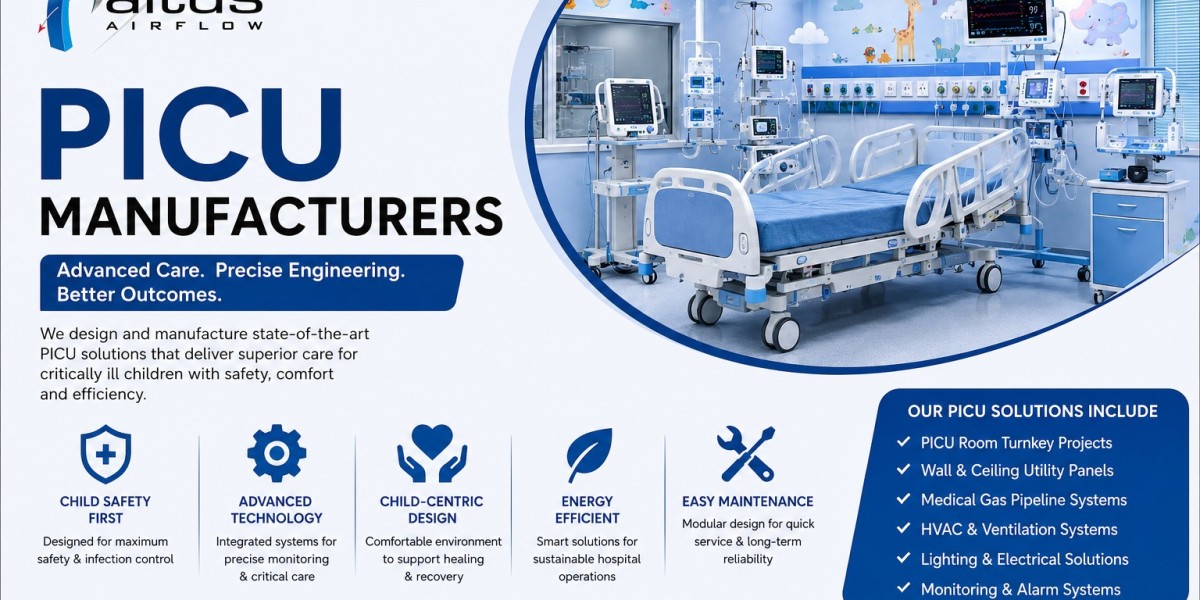
Experienced PICU Manufacturers support hospitals by helping them plan and develop specialised pediatric critical care infrastructure. Their contribution may include space planning, modular interior systems, bedside utility coordination, equipment interfaces and installation support. By understanding the operational requirements of pediatric intensive care, manufacturers can help healthcare facilities create organised environments that accommodate specialised treatment and monitoring needs.
Understanding the Role of PICU Manufacturers in Modern Hospitals
A PICU is different from a general hospital ward or an adult intensive care unit. It is designed specifically for infants and children who require close observation, advanced medical support and specialised nursing care.
The Consensus Guidelines for Pediatric Intensive Care Units in India, published in 2020, cover unit design, equipment, organisation, staffing and support services. They provide recommendations for healthcare institutions establishing new PICUs or modifying existing facilities.
Manufacturers contribute primarily to the physical and technical infrastructure of these facilities. Depending on the project scope, their services may cover:
Planning patient care areas and room layouts.
Providing modular wall and ceiling systems.
Coordinating medical gas and electrical outlets.
Supporting ventilation and environmental planning.
Integrating equipment and monitoring interfaces.
Providing installation and technical documentation.
The hospital's clinical leadership and engineering teams must determine the medical, staffing and operational requirements. Manufacturers help translate the agreed requirements into a practical infrastructure solution.
Key Ways PICU Manufacturers Support Advanced Pediatric Healthcare Facilities
1. Planning Dedicated Pediatric Intensive Care Spaces
The first important contribution is helping hospitals develop a layout that reflects the needs of pediatric patients and healthcare professionals. The design should provide sufficient space around each bed for monitoring equipment, medical procedures and emergency access.
Manufacturers can coordinate the placement of patient beds, service panels, storage facilities and essential utility connections. The layout should also consider access to the central monitoring station and nearby hospital departments.
The Indian Academy of Pediatrics' 2020 consensus guidelines recommend a dedicated PICU separate from neonatal and adult ICUs. They also discuss patient bed areas, access to emergency services and arrangements for observation and clinical procedures.
2. Providing Modular Wall and Ceiling Infrastructure
Modular construction can help hospitals organise specialised interiors using prefabricated components. Depending on the project specification, PICU manufacturers may provide modular wall panels, ceiling systems, sealed joints and provisions for integrating medical services.
These components should be selected with durability, hygiene and maintenance in mind. Smooth, non-porous and easy-to-clean surfaces can support routine cleaning procedures in intensive care environments.
Hospitals should evaluate the proposed materials, finishes, installation methods and technical documentation before approving the design. Access to concealed services should also be considered to simplify future inspections and maintenance.
3. Supporting Medical Gas and Bedside Utility Arrangements
PICU beds require access to essential medical services. Depending on the planned level of care, these may include oxygen, medical air, suction and electrical connections for patient monitoring and treatment equipment.
Manufacturers can help coordinate the position of bedside service panels and utility outlets according to the approved layout. The arrangement should allow healthcare professionals to access essential services without creating unnecessary obstruction around the patient.
The Indian Academy of Pediatrics guidelines discuss recommended bedside oxygen, air, suction and electrical outlet provisions. Hospitals should use the applicable clinical and engineering requirements to determine the final configuration for each project.
4. Enabling Better Equipment and Monitoring Integration
Advanced pediatric care depends on appropriate monitoring and medical equipment. A PICU may require multiparameter monitors, infusion pumps, ventilators, defibrillators and other specialised devices according to its intended level of care.
Manufacturers support infrastructure planning by coordinating equipment positions, service connections, power requirements and available working space. This helps ensure that equipment can be accessed by healthcare professionals without interfering with patient care activities.
Hospitals should finalise equipment requirements with pediatric intensivists and biomedical engineers before completing the infrastructure design. Equipment compatibility, maintenance access and technical support availability should also be considered.
5. Coordinating Ventilation and Environmental Systems
Ventilation and environmental control are important elements of a pediatric critical care facility. The proposed systems should address the hospital's requirements for air movement, temperature management, filtration and environmental monitoring.
Manufacturers may coordinate HVAC provisions with the room layout, modular ceilings and other installed services. The design should also consider any isolation rooms or specialised ventilation arrangements required by the facility.
The Ministry of Health and Family Welfare's guidance on operationalising COVID care services for children and adolescents identifies ventilation, air-handling systems, medical gas supply and uninterrupted electricity as important considerations for pediatric critical care areas.
Final HVAC specifications and performance validation should be handled by qualified engineering professionals in accordance with applicable requirements.
6. Supporting Infection Prevention Through Facility Design
Infection prevention is a major consideration in intensive care environments. The physical layout should support cleaning, appropriate patient separation and organised movement of staff and supplies.
Manufacturers can contribute by providing hygienic finishes, well-sealed surfaces and practical access to areas that require regular cleaning. The design may also incorporate isolation facilities where required by the hospital's clinical planning.
The National Guidelines for Infection Prevention and Control in Healthcare Facilities highlight the importance of infection prevention practices across clinical departments, including pediatric and intensive care services.
Hospitals should involve their infection control teams when reviewing the design and selecting construction materials.
7. Improving Lighting, Accessibility and Patient Comfort
A PICU should provide sufficient lighting for examinations, monitoring and medical procedures. At the same time, its environment should consider the comfort of young patients and their families.
Manufacturers can coordinate lighting positions, electrical provisions, bedside arrangements and interior finishes. Where appropriate, design choices may also consider sound-absorbing materials, suitable colour schemes and family access.
The Indian Academy of Pediatrics guidelines discuss sound-absorbing surfaces, suitable lighting and child-friendly environmental features as desirable aspects of PICU design.
These considerations can help hospitals develop a more organised and supportive care environment.
Infrastructure Features That Matter in Advanced PICUs
Patient Bedside Organisation
Each patient area should provide suitable space for clinical procedures, monitoring devices and emergency access. The placement of beds, service outlets and equipment should allow healthcare professionals to work efficiently.
Manufacturers can coordinate the physical infrastructure with the hospital's selected equipment and clinical workflow requirements. The final layout should be reviewed by the medical and nursing teams before installation.
Isolation and Support Areas
Depending on the facility's needs, a PICU may require isolation rooms, clean and dirty utility rooms, storage areas and staff support spaces. These areas should be considered during the initial planning stage rather than added without sufficient coordination later.
The design should also account for the movement of patients, staff, supplies and waste. Clear separation of functions can support organised daily operations.
Pediatric Intensive Care Environment Integration
Advanced pediatric facilities need different infrastructure systems to operate together. Pediatric Intensive Care Environment Integration involves coordinating patient spaces, bedside utilities, monitoring equipment, ventilation and essential support services within one practical design.
Manufacturers can help hospitals assess these interfaces during planning and installation. Collaboration with pediatric specialists, biomedical engineers, architects and facility managers is important to ensure that the infrastructure reflects actual care requirements.
How Hospitals Can Evaluate PICU Manufacturers
Selecting a manufacturer requires more than reviewing product catalogues or comparing quotations. Hospitals should examine the provider's technical capabilities and ability to address the specific requirements of pediatric critical care.
Review Relevant Healthcare Project Experience
Hospitals should examine previous projects involving intensive care infrastructure or other specialised healthcare environments. Ask about the scope of work, components supplied and installation responsibilities.
Relevant experience can help decision-makers understand whether the manufacturer is familiar with the coordination challenges associated with critical care facilities.
Check Technical Specifications and Material Quality
Request details about modular panels, flooring, ceilings, utility interfaces and other proposed components. Evaluate durability, cleanability, maintenance access and supporting technical documentation.
Hospitals should also verify whether the proposed materials and systems are suitable for the intended clinical environment.
Assess Equipment and Utility Coordination
The manufacturer should demonstrate how the proposed layout accommodates medical gas connections, electrical outlets, monitoring equipment and other bedside services.
The hospital's biomedical and engineering teams should review these arrangements to identify possible compatibility or access issues before installation.
Understand Installation and Commissioning Responsibilities
Hospitals should clarify whether the manufacturer provides design, fabrication, supply, installation, integration and commissioning services. Any responsibilities assigned to separate contractors should be documented.
A clear project scope helps avoid gaps between different service providers and makes it easier to track installation progress.
Confirm Documentation and After-Sales Support
Before finalising an agreement, hospitals should ask about technical drawings, installation records, warranty conditions and maintenance assistance.
They should also understand how technical issues will be handled after handover and whether replacement components or service support will be available when required.
Why Collaboration Between Manufacturers and Hospital Teams Matters
Developing an advanced PICU is a collaborative process. Manufacturers can provide infrastructure expertise, but the hospital's clinical and technical teams must guide the project according to patient care requirements.
Pediatric intensivists can explain clinical workflows and equipment needs. Nursing representatives can provide input on bedside access and daily operations. Biomedical engineers can review equipment compatibility, while architects and facility managers can assess space planning and building services.
Early collaboration helps identify practical challenges before construction or installation begins. It also allows the project team to establish clear responsibilities, technical specifications and handover requirements.
Conclusion
PICU manufacturers support advanced pediatric healthcare facilities by helping hospitals develop specialised infrastructure for critical care. Their contributions can include layout planning, modular construction, bedside utility coordination, equipment integration, ventilation planning, hygienic finishes and installation support. Each element must be considered in relation to the hospital's clinical requirements and intended level of pediatric care.
Choosing experienced PICU Manufacturers can help healthcare facilities coordinate these infrastructure requirements through a structured planning and implementation process. Hospitals should evaluate technical expertise, material quality, project experience, equipment compatibility and after-sales support before selecting a provider. A carefully coordinated PICU environment can provide a practical foundation for healthcare professionals delivering specialised treatment to young patients.
Frequently Asked Questions
1. How do PICU manufacturers support modern hospitals?
PICU manufacturers support hospitals by providing specialised infrastructure solutions such as modular interiors, patient area planning, bedside utility arrangements, equipment interfaces and installation services. Their work helps translate hospital requirements into a functional critical care environment.
2. What infrastructure is required in a pediatric intensive care unit?
A PICU may require patient beds, monitoring equipment, ventilators, medical gas connections, electrical outlets, suction facilities, ventilation systems, isolation arrangements and dedicated support spaces. Requirements depend on the intended level of care and applicable guidelines.
3. Why is modular construction useful for PICU facilities?
Modular construction can provide organised interior systems with specialised wall and ceiling components. When appropriately specified, these systems can support hygienic finishes, coordinated utility integration and practical maintenance access.
4. What should hospitals check before selecting PICU manufacturers?
Hospitals should review previous project experience, technical capabilities, material specifications, equipment coordination, installation procedures, commissioning documentation and after-sales support. Clinical and engineering teams should also participate in evaluating the proposed design.
5. Do PICU manufacturers provide medical equipment and clinical services?
The scope varies between providers. Some may coordinate or supply selected infrastructure and equipment interfaces, while others focus on modular construction and installation. Clinical staffing, medical protocols and patient treatment remain the responsibility of the healthcare facility.
Read Our Previous Blog-----------> What Factors Should You Consider When Choosing a Modular OT Setup Company?