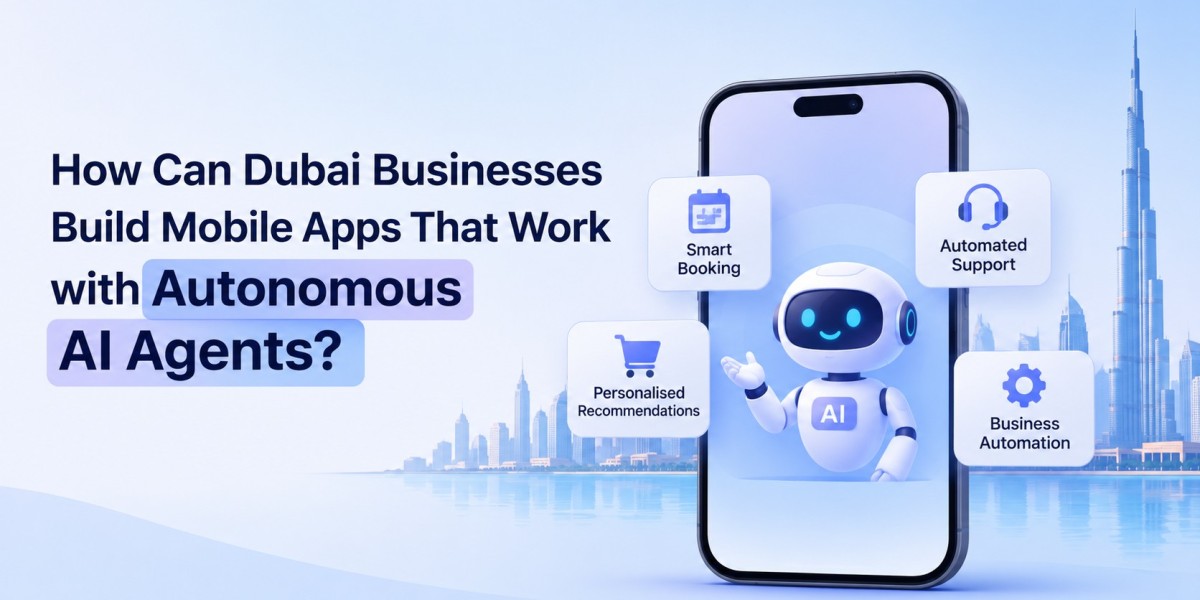

Autonomous AI agents are changing how businesses manage digital operations, interact with customers and automate complex tasks. Unlike traditional AI tools that mainly respond to user requests, AI agents can analyse information, make decisions and perform multi-step actions with limited human intervention.
For businesses in Dubai, this creates new opportunities to develop smarter mobile applications that go beyond traditional features. By integrating autonomous AI agents, companies can enable automated customer support, intelligent booking management, personalised recommendations, real-time task execution and business process automation.
Working with an experienced mobile app development company in Dubai can help businesses identify suitable AI use cases and integrate agent-based capabilities into their applications. The right mobile app development strategy should combine AI models, secure APIs, reliable data sources and user-friendly interfaces to deliver practical business value.
1. Understanding Autonomous AI Agents in Mobile Applications
Autonomous AI agents are software systems designed to understand goals, process information, make decisions and execute tasks. They can connect with external tools, APIs and business systems to complete actions rather than simply generate responses.
For example, an AI-powered business application could allow users to request a service, compare available options, schedule an appointment and receive confirmation through a single conversation.
Unlike conventional chatbots, AI agents can manage multiple connected steps and adapt their actions based on changing information.
2. How Dubai Businesses Can Use Autonomous AI Agents in Mobile Apps
Businesses across different industries can introduce agent-based functionality to improve customer experiences and operational efficiency.
Retail and eCommerce: AI agents can help customers discover products, compare options, check availability and manage purchases.
Fintech: Financial applications can use AI agents to categorise transactions, answer account-related queries and assist with financial workflows.
Healthcare: AI agents can support appointment scheduling, patient queries and administrative coordination.
Real Estate: Property applications can recommend listings, arrange property viewings and answer questions about available properties.
Travel and Hospitality: AI agents can help users plan itineraries, manage bookings and receive personalised travel recommendations.
Logistics: Applications can use AI agents to monitor delivery updates, identify delays and support operational coordination.
3. Essential Technologies Behind AI Agent-Powered Mobile Apps
Building an application with autonomous AI capabilities requires more than integrating a language model. Businesses need a technology architecture that supports intelligent decision-making, secure execution and reliable communication.
Key technologies include:
Large Language Models (LLMs): Understand user requests and generate context-aware responses.
Agent Frameworks: Coordinate multiple AI agents and manage task execution.
Retrieval-Augmented Generation (RAG): Connect AI agents with relevant business information and knowledge bases.
API Integrations: Allow agents to interact with payment systems, CRMs, booking platforms and enterprise applications.
Vector Databases: Store and retrieve information based on semantic similarity.
Cloud Infrastructure: Support scalability, processing and application availability.
Identity and Access Management: Control what actions AI agents can perform and which data they can access.
4. Important Features to Include in AI Agent-Powered Mobile Applications
Businesses should prioritise features that solve actual customer or operational problems.
Conversational AI interfaces for natural user interactions.
Multi-step task execution for completing connected activities.
Personalised recommendations based on user preferences.
Real-time notifications and workflow updates.
Integration with third-party business platforms.
Human approval for sensitive or high-impact actions.
Activity logs to monitor AI decisions and executed tasks.
Secure authentication and permission management.
These capabilities can make mobile applications more useful while maintaining transparency and user control.
5. Security and Governance Considerations for Autonomous AI Agents
Autonomous agents may access business data and execute actions through connected systems. Therefore, security must be considered from the beginning of development.
Businesses should implement role-based access controls, encrypted data transmission, secure API authentication and activity monitoring. Sensitive actions, such as financial transactions or changes to important customer records, should require appropriate user approval.
For UAE businesses, data protection requirements and applicable regulatory obligations should also be considered when designing AI-powered applications.
6. How to Build an AI Agent-Powered Mobile App in Dubai
A structured development process helps businesses introduce autonomous AI capabilities without making the application unnecessarily complex.
Identify business use cases: Select tasks where AI agents can deliver measurable value.
Define agent responsibilities: Establish what each agent can access, decide and execute.
Choose the technology stack: Select suitable AI models, frameworks, databases and cloud services.
Design the application experience: Create an intuitive interface for interacting with AI agents.
Integrate business systems: Connect relevant APIs, databases and third-party platforms.
Implement security controls: Establish permissions, approval workflows and monitoring.
Test and deploy: Evaluate accuracy, performance, reliability and security before launch.
Monitor and improve: Review agent performance and refine workflows using real-world feedback.
7. Why Businesses Need the Right Mobile App Development Partner
Developing an autonomous AI-powered application requires expertise in mobile engineering, AI integration, backend architecture, API connectivity and application security.
A professional mobile app development company in Dubai can help businesses plan the right architecture, select suitable AI technologies and integrate autonomous capabilities into their existing digital systems.
The development partner should also understand the importance of scalability, data privacy, testing and ongoing AI model optimisation.
Conclusion
Autonomous AI agents are creating new possibilities for mobile applications by enabling intelligent task execution, personalised interactions and connected business workflows. For Dubai businesses, adopting these capabilities can help improve operational efficiency and create more advanced digital experiences.
However, successful implementation depends on selecting the right use cases, establishing strong security controls and building a scalable application architecture. With a well-planned mobile app development strategy, businesses can turn autonomous AI capabilities into practical solutions that support long-term growth.







