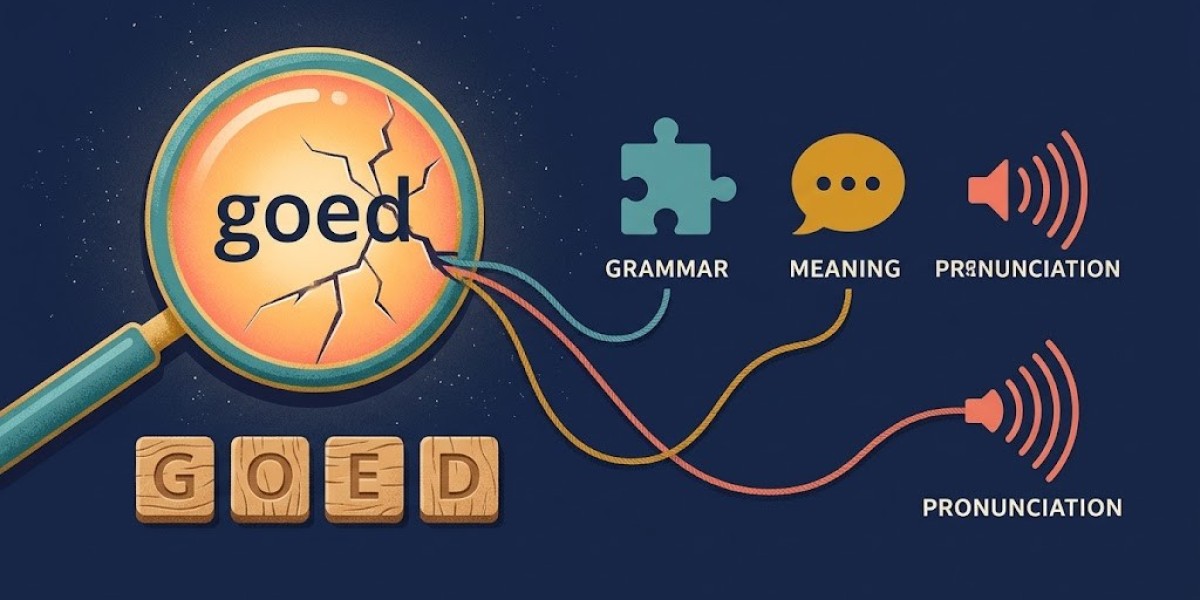

A learner completes a past simple gap-fill without a single slip. Ten minutes later, in conversation, they say, “I goed there with my brother.”
Frustrating? A little. Useful? Enormously.
Most of us spot the wrong word, supply the right one and move on. But the visible error is only the first clue. The same sentence can come from a grammar gap, slow retrieval under pressure, confused meaning or a sound the learner cannot yet hear.
Diagnose first. Correct second.
What an Error Actually Tells You
Learners do not collect rules and apply them perfectly. They test patterns, watch what happens and adjust.
Take “I goed to school yesterday.” The learner has probably noticed that English usually adds -ed for past time and stretched that pattern too far. This is overgeneralisation, and it shows thinking, not carelessness.
Here is something many people miss. Researchers have described a pattern called U-shaped development. A learner first uses an irregular form such as went correctly, often as a memorised chunk. Later, accuracy appears to dip as they begin producing goed. Eventually, with more exposure, the correct form returns.
That pattern only shows up over time. A single goed cannot tell you which stage a learner is in. It might be overgeneralisation, a slip or a form they never fully learnt. What it does give you is a reason to look at their earlier and later language before deciding.
There is also a difference between an error and a mistake. An error points to incomplete knowledge. A mistake is a slip by someone who knows better. One sentence rarely tells you which.
One Sentence, Several Explanations
Consider “I am agree with you.” The learner may be borrowing a pattern from their first language. They may think agree is an adjective. They may have just learnt “I am interested” and extended it. The sentence alone cannot settle it.
Sample answers, including those found through a CELTA Assignment Writing Service UK, are only as strong as their analysis. The same discipline applies to your own work: keep what you can see separate from what you are guessing.
Spotting a missing auxiliary is an observation. Claiming it went missing because of first-language interference is a hypothesis, and it needs evidence.
Pronunciation works the same way. A learner who says ship for sheep may be unable to produce the vowel. They may also be unable to hear the difference. Those problems are related, but they are not the same.
Meaning hides easily too. “I borrowed him my book” looks like a grammar slip, yet the real issue is two close verbs: borrow and lend. Fix the grammar and you have missed the point.
Concepts Worth Knowing
Interlanguage is the evolving system a learner builds from their first language, the English around them and their own hunches. It is often systematic, which is why errors repeat.
First-language influence is a real factor, but it should never be the automatic answer.
Three plain categories help you describe what happened:
- Omission: “She going home.”
- Addition: “She didn’t went.”
- Misformation: “He have finished.”
These describe what happened, not why.
A Three-Question Test You Can Use Tomorrow
When an error puzzles you, ask three things about the target language:
- Can they hear it? Play two options and ask which they heard.
- Can they choose it? Offer a choice in context.
- Can they produce it? See whether it appears unprompted.
Treat the answers as leads, not verdicts. Choosing correctly but failing to produce might suggest a retrieval or fluency issue. It might equally mean partial knowledge, uncertainty about the context or success through recognition rather than understanding.
Test each hunch with another example or a different task before you act on it.
Watch for Avoidance
A learner who never errs with the present perfect may simply never attempt it. If a taught structure never turns up in speech, treat that silence as evidence too.
Worked Example: “I Have Seen Him Yesterday”
The intended meaning is a meeting at a finished time. The observable problem is a present perfect combined with a finished-time expression.
Now investigate. Does the pattern recur? Does it hold when the context changes? Can the learner explain the contrast with I saw him yesterday? Let the answers shape your response.
A Quick Triage for Busy Lessons
You cannot fix everything. Ask:
- Does it block meaning?
- Does it repeat?
- Is it teachable now?
If the answer to all three is no, it can usually wait.
Mistakes to Avoid
Assuming an error proves ignorance. Many learners know a rule on paper and lose it mid-conversation.
Correcting every slip. In accuracy work, correct immediately. In fluency work, note recurring problems and give feedback afterwards.
Mistaking accent for error. The real question is whether a pronunciation makes a word hard to recognise.
Bringing It Together
Good error analysis means reading learner language carefully and resisting the urge to claim more than the evidence supports. Often you will need another example, a quick question or a different task before you can judge sensibly.
An error shows what a learner has not yet mastered. It also shows which pattern they are testing and where their knowledge is still unreliable.
That is what turns analysing learner language from a correction exercise into real teaching.







