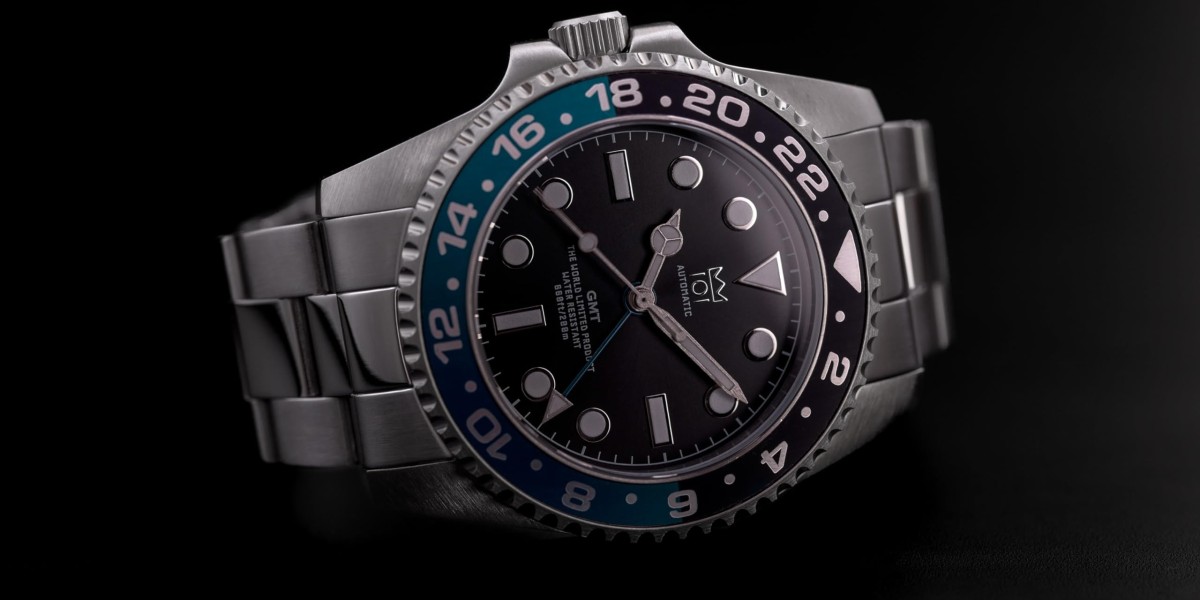

Keeping track of time becomes more complicated when your day involves different countries. You might travel for work, speak with family overseas, or coordinate meetings with international clients. A GMT watch brings a second time zone to your wrist, making those connections easier to manage. Beyond its practical function, it also offers an appealing combination of watchmaking detail and everyday style. Understanding how GMT watches work can help you decide whether this feature belongs in your next timepiece.
What Is a GMT Watch?
GMT stands for Greenwich Mean Time, a reference used when discussing time differences around the world. A GMT watch typically displays local time alongside a second time zone through an additional hour hand.
Unlike the standard hour hand, which circles the dial twice daily, the GMT hand usually completes one rotation every 24 hours. It points to a corresponding 24-hour scale on the dial or bezel. This arrangement helps distinguish morning from evening in the second location. The additional hand does not have to display Greenwich time; you can use it for another reference location.
How to Read a GMT Watch
Reading a GMT watch becomes straightforward once you separate its two hour displays. Read local time using the regular hour and minute hands. Then read the additional hour hand against the 24-hour scale.
For example, if the GMT hand points to 18 and the minute hand points to 12, the reference time is 6:00 p.m. If it points to 6, the reference time is 6:00 a.m.
On conventional GMT watches, the minute hand serves both displays. Time zones with half-hour or quarter-hour differences require special consideration because not every GMT movement can represent these offsets independently.
Traveler GMT Versus Caller GMT
Two common terms appear when comparing GMT watches: traveler GMT and caller GMT. The distinction concerns which hour hand adjusts independently.
A traveler GMT allows the regular local hour hand to move independently, commonly in one-hour jumps. This is convenient when arriving in another time zone because you can change local time while preserving your reference display. Grand Seiko describes this independent hour adjustment as a useful feature for keeping track of home time abroad.
A caller GMT allows independent adjustment of the additional GMT hand. This arrangement suits someone who stays in one location but frequently checks time elsewhere. Neither approach is automatically better; usefulness depends on your routine.
What Does the Rotating Bezel Do?
Some GMT watches have a rotating bezel marked with a 24-hour scale. Moving this scale changes the reference against which you read the GMT hand, allowing you to check another time zone.
Certain designs support tracking three zones through the local hands, a fixed 24-hour scale, and the rotating bezel. However, this capability depends on the watch’s layout. A rotating bezel alone does not guarantee three equally accessible displays. TUDOR provides model-specific instructions for using its GMT watches across three time zones.
Who Can Benefit From a GMT Watch?
Frequent travelers are obvious candidates, but the function has value beyond airports. Professionals working with international teams can keep a colleague’s time zone visible during the day.
People with friends or relatives overseas may appreciate knowing whether it is a reasonable hour to call. Remote workers can also use the second display when organizing appointments across borders.
Even occasional travelers may enjoy the convenience. The important question is whether checking another time zone forms a meaningful part of your life, rather than whether you travel constantly.
Features to Consider Before Buying
Start with readability. A distinctive GMT hand and clear 24-hour markings make the additional display easier to use. Attractive styling matters, but the information should remain legible at a glance.
Next, consider case dimensions, thickness, and comfort. A watch that feels bulky or catches on clothing may receive less wrist time than expected.
Review the movement type, water resistance, crystal material, and maintenance requirements. Check the setting procedure as well. Understanding how the hands and date interact will help you choose a watch that feels practical to operate.
Setting and Using Your Watch
Always follow the manufacturer’s instructions when setting a GMT watch. Crown positions, date adjustments, and restrictions vary between movements.
Decide which location belongs on each display, then check both morning and evening indications carefully. Remember that daylight saving changes may alter the difference between locations during the year.
After traveling, confirm the local date as well as the hour. These small checks help prevent scheduling mistakes and make the GMT function more dependable in everyday use.
Choosing the Right GMT Watch
The best GMT watch combines useful functionality with a design you enjoy wearing. Compare adjustment styles, prioritize comfort, and choose clear displays. A well-chosen GMT watch keeps distant places within easy reach.