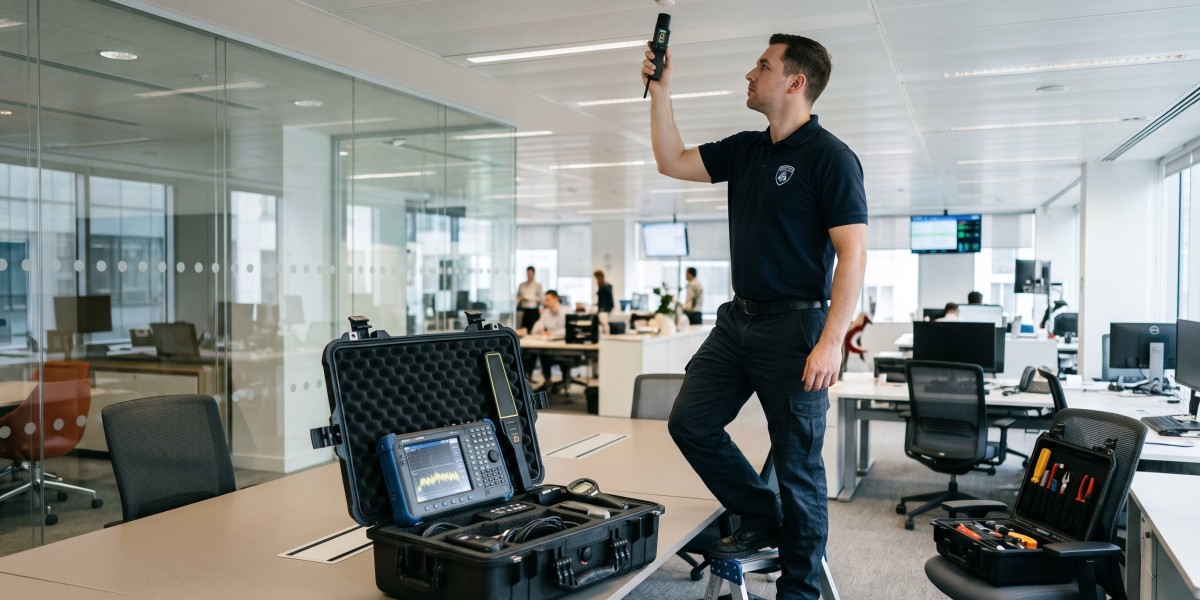

Businesses handle confidential information every day, from financial records and client discussions to strategic plans and sensitive negotiations. However, unauthorized surveillance can put this information at risk without obvious signs. A professional commercial hidden camera service helps organizations identify potential covert cameras and other unauthorized monitoring devices through a structured Technical Surveillance Countermeasures (TSCM) inspection. These services are designed to detect potential surveillance threats, investigate suspicious devices, and help businesses maintain greater control over their private environments.
For organizations that regularly discuss confidential matters, workplace privacy is not simply a security preference. It is an important part of protecting business operations, professional relationships, and sensitive information. Understanding how covert surveillance can occur and how professional inspections work can help decision-makers take appropriate precautions.
Why Is Hidden Camera Detection Important for Businesses?
Modern surveillance devices can be compact and difficult to recognize. Some cameras may be concealed within everyday objects, while others can be installed in meeting rooms, offices, or private workspaces. Although legitimate security cameras are commonly used in commercial properties, unauthorized recording creates different concerns, especially when confidential conversations or restricted information are involved.
A suspicious device does not automatically prove that surveillance is taking place. It should be assessed carefully by qualified professionals who understand the difference between authorized security equipment and potential surveillance threats.
Businesses may benefit from professional inspections when they need to protect:
Executive offices and private meeting rooms.
Boardrooms used for strategic discussions.
Legal offices and confidential consultation spaces.
Financial departments handling sensitive records.
Research and development areas.
Rooms used for mergers, acquisitions, or contract negotiations.
Identifying potential surveillance risks early can help organizations reduce uncertainty and make informed security decisions.
What Does a Commercial Hidden Camera Service Include?
A professional commercial hidden camera service focuses on examining business environments for signs of unauthorized visual surveillance. Depending on the provider, the inspection may also form part of a broader TSCM assessment that considers other potential technical monitoring threats.
The inspection process should be based on the property's security requirements, the sensitivity of the information being protected, and any specific concerns reported by the client.
1. Physical Inspection of Business Premises
A physical inspection allows trained specialists to examine accessible areas for unusual objects, unexpected modifications, or equipment that appears inconsistent with the room's normal setup.
Attention may be given to meeting rooms, office furniture, decorative objects, fixtures, and other areas where an unauthorized camera might potentially be concealed.
During this process, professionals may:
Examine relevant objects for signs of tampering.
Check suspicious equipment and unfamiliar installations.
Review camera-like objects that lack a clear business purpose.
Document findings that require additional investigation.
Recommend appropriate follow-up checks when necessary.
Physical inspection is an important part of a thorough assessment, although it cannot guarantee that every concealed device will be identified.
2. Technical Assessment for Potential Surveillance Devices
Some surveillance equipment may not be identifiable through visual inspection alone. Depending on the suspected threat, specialists may use suitable technical equipment to investigate potential electronic surveillance activity.
The methods used will vary according to the environment, device characteristics, and scope of work. A qualified provider should explain which inspection methods are appropriate and what their limitations are.
A professional assessment may consider:
Potentially suspicious electronic equipment.
Relevant radio-frequency activity, where applicable.
Unusual devices or installations requiring further examination.
Findings that may warrant a more detailed TSCM investigation.
It is important to understand that not every electronic signal indicates surveillance. Ordinary business equipment, wireless networks, and neighboring devices can generate signals that require careful interpretation.
3. Inspection of Confidential Meeting Areas
Meeting rooms are especially important because sensitive discussions frequently take place there. An unauthorized recording device could potentially expose information about business strategy, negotiations, intellectual property, or client relationships.
A targeted inspection can help organizations assess these spaces according to their confidentiality requirements.
Areas that may receive additional attention include:
Executive conference rooms.
Private meeting rooms.
Rooms used for sensitive client consultations.
Offices where financial or legal matters are discussed.
Temporary meeting spaces used for confidential negotiations.
The inspection scope should be agreed upon in advance, with particular attention given to access permissions and any applicable privacy requirements.
What Are the Warning Signs of Possible Hidden Surveillance?
Businesses should avoid assuming that every unfamiliar object is a recording device. Nevertheless, certain observations may justify a closer examination by a qualified security professional.
Potential warning signs include:
Unexplained changes to office fixtures or equipment.
Objects that appear to have been recently modified.
Unfamiliar electronic devices in restricted areas.
Equipment that cannot be matched to an authorized inventory.
Unexpected signs of tampering around sensitive rooms.
Credible concerns about unauthorized access to confidential spaces.
These indicators are not proof of covert surveillance. They are reasons to document the concern and arrange an appropriate assessment rather than attempting to reach conclusions without evidence.
If a potentially suspicious device is discovered, avoid dismantling it unnecessarily. Record its location, restrict access when appropriate, and follow your organization's security procedures. If a serious incident is suspected, consult qualified security professionals and the relevant legal or law enforcement authorities as appropriate.
How Can Businesses Choose the Right TSCM Provider?
Selecting a provider requires more than comparing service prices. Organizations should consider the provider's technical capabilities, inspection methodology, reporting standards, and experience with commercial environments.
A reliable commercial hidden camera service should be supported by a clearly defined inspection process and realistic explanations of what the assessment can establish.
Check Experience and Technical Expertise
Ask whether the provider has experience inspecting commercial premises and handling confidentiality-sensitive environments. The team should be able to explain its methodology in straightforward language without making unsupported claims about detecting every possible device.
Relevant questions include:
What types of inspections are included?
Which areas and devices will be assessed?
What technical methods may be used?
How are suspicious findings verified?
What happens if additional investigation is needed?
Clear answers help businesses understand the service before granting access to private premises.
Review Reporting and Confidentiality Practices
Inspection findings can involve sensitive information about a company's physical security. For this reason, reports should be handled carefully and shared only with authorized personnel.
Before hiring a provider, ask about documentation, information storage, confidentiality agreements, and procedures for reporting potential threats.
A professional report may include the areas inspected, the methods used, relevant findings, identified limitations, and recommended next steps. Any conclusions should be supported by observations or technical evidence rather than speculation.
Confirm the Scope of Work
Not every business needs the same level of inspection. A small professional office may have different requirements from a corporate headquarters with multiple confidential meeting rooms.
The scope should be established before the inspection begins. This helps prevent misunderstandings about which rooms, devices, and potential threats are included in the service.
Businesses should also confirm whether repeat inspections, follow-up assessments, or additional TSCM services are available if circumstances change.
How Often Should Commercial Properties Be Inspected?
There is no universal inspection schedule that suits every organization. The appropriate frequency depends on the sensitivity of business information, the likelihood of unauthorized access, and the organization's overall security policies.
Some businesses may arrange inspections before important negotiations or after a credible security concern has been reported. Others may incorporate assessments into a broader risk management program.
An inspection may be worth considering when:
A confidential meeting is scheduled with particularly sensitive information involved.
A suspicious device or unexplained modification has been identified.
Office renovations or equipment changes have occurred.
A business has experienced a possible security breach.
A new office or meeting space is being prepared for confidential work.
Repeat inspections should be based on a reasonable assessment of risk. They should not be presented as a guarantee against future surveillance, because a property's security conditions can change after an assessment has been completed.
How Hidden Camera Detection Supports Business Confidentiality
Protecting confidential information requires several complementary security measures. Professional detection services can help identify potential physical surveillance risks, but they work best alongside established access controls, staff awareness, and information security practices.
Businesses can strengthen their overall approach by:
Limiting access to sensitive rooms.
Maintaining an inventory of authorized security equipment.
Reviewing visitor access and contractor procedures.
Establishing a process for reporting suspicious devices.
Training staff to recognize and report unusual changes.
Protecting confidential documents and digital communications.
Arranging professional inspections when justified by risk.
These measures help organizations respond to security concerns systematically. They also reduce the likelihood that an unfamiliar device or unexplained incident will be overlooked.
Where a suspected surveillance incident is identified, evidence should be documented and handled according to appropriate procedures. Any corrective action should be proportionate to the findings and consistent with applicable laws.
Final Thought
A professional commercial hidden camera service can play an important role in helping businesses investigate potential covert surveillance and protect confidential working environments. Through appropriate physical inspections, relevant technical assessments, and evidence-based reporting, organizations can gain a clearer understanding of potential security risks. However, no inspection can guarantee that every device or threat will be detected. The most effective approach combines qualified TSCM expertise with sensible access controls, clear reporting procedures, and ongoing attention to workplace confidentiality. By taking these steps, businesses can make more informed security decisions and build a stronger foundation for protecting sensitive conversations, commercial information, and professional trust.