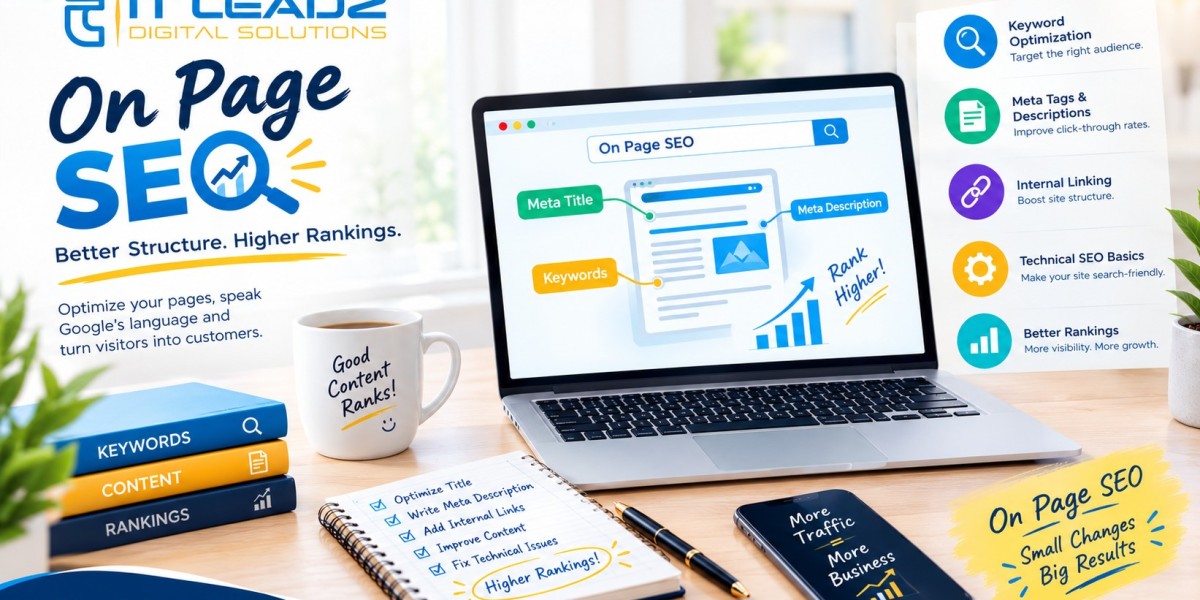

On Page SEO is the practice of optimizing the content, structure and code of individual web pages so that search engines and AI systems can understand them and users find them useful. It covers everything you control directly on the page titles, headings, body copy, images, internal links, URLs, schema markup and page experience. Unlike offpage work such as backlink building, On Page SEO is entirely within your control, which makes it the most dependable starting point for any organic growth plan. Think of every page on your website as a candidate answering a question. Search engines compare thousands of candidates and pick the ones that match intent, demonstrate expertise and load without friction.
On Page SEO is how you make your page the obvious candidate. Done well, it improves rankings, clickthrough rates, engagement and conversions at the same time. Many businesses treat optimization as a one off task of inserting keywords. That approach stopped working years ago. Modern search systems read pages semantically, evaluate entities and relationships, and increasingly summarize content inside AIgenerated answers. If you want help building a structured programme rather than patching pages one by one, a specialist team offering On Page SEO Services can audit your pages and turn findings into a prioritized roadmap.
Why OnPage SEO Still Matters
Search remains one of the largest sources of website traffic for most industries. Google alone is commonly cited as processing more than eight billion searches a day, and a very large share of web sessions begin with a search query. If your pages are not optimized, they simply do not compete for those sessions. Position matters enormously. One widely cited industry study found that the first organic result earns roughly 27 to 28 percent of clicks, while results lower on the page earn a small fraction of that.
Moving from the bottom of page one to the top three can multiply traffic without publishing a single new page. That is the commercial logic behind optimizing what you already have. OnPage SEO also compounds. A well structured page earns better engagement signals, attracts natural links, feeds internal linking and supports other pages in the same topic cluster. Every improvement lifts the pages around it.
The Core Elements of On Page SEO
Before going deeper, here is a quick reference of the main elements, what they do and the practical target for each.
Element | Purpose | Practical Target |
Title tag | Tells search engines and users what the page is about | About 50 to 60 characters, primary keyword near the start |
Meta description | Persuades users to click from results | About 140 to 160 characters, clear benefit and call to action |
H1 heading | States the page topic on the page itself | One per page, matches search intent |
URL | Gives a short, readable page address | Short, lowercase, hyphenseparated, keywordled |
Body content | Answers the query completely | Depth that matches intent, not padding |
Image alt text | Describes images for accessibility and image search | Concise, descriptive, natural |
Internal links | Passes context and authority between pages | Relevant anchors, logical paths |
Schema markup | Labels content for machines | Valid structured data matching visible content |
Page speed | Reduces friction | LCP under 2.5s, INP under 200ms, CLS under 0.1 |
Each row in this table deserves attention, and the sections below explain how to handle them.
Understanding Search Intent First
The single most important decision in optimization happens before you touch the page understanding what the searcher actually wants. Search intent usually falls into four groups, informational (learn something), navigational (find a specific site), commercial (compare options) and transactional (buy or hire). If someone searches “what is OnPage SEO,” they want a definition and a framework. If they search “OnPage SEO consultant,” they are close to hiring. A page that mixes the two without clarity satisfies neither. Review the current top results for your target query, note the format they use (guide, checklist, service page, comparison) and match that format while adding something better, more clarity, more evidence, better structure.
Keyword Research and Mapping
Keyword research tells you what language your audience uses. Mapping assigns each target query to exactly one page so your own pages never compete with each other. Start with a primary keyword, then collect variations, related questions and entities that naturally belong in the topic.
For example, a page about OnPage SEO might also cover phrases such as On Page SEO techniques, OnPage SEO factors, OnPage keyword optimization and OnPage SEO implementation. These are not separate pages; they are supporting vocabulary that makes the page semantically complete. Search engines use this vocabulary to confirm that you cover the topic properly. When you want to see how a professional workflow turns raw keyword data into optimized pages, reviewing how an experienced OnPage SEO Company structures research, mapping and implementation is a useful benchmark.
Writing Title Tags That Earn Clicks
The title tag is the strongest on page relevance signal and the headline users see in results. Put the primary keyword early, keep it within roughly 60 characters so it is not truncated, and write it for humans first. A good title promises a specific outcome.
Weak “Home | OnPage SEO.”
Better “OnPage SEO Guide Strategies, Factors & Best Practices.”
Avoid stuffing multiple keyword variations into a single title. One clear primary phrase plus a benefit or qualifier is enough. Test titles by checking clickthrough rate in Google Search Console after changes.
Crafting Meta Descriptions
Meta descriptions do not directly raise rankings, but they influence whether people click. Google may rewrite them, yet a strong description still gives you the best chance of controlling your snippet. Write one unique description per page, include the primary keyword naturally, state the benefit and finish with a soft action such as “learn how” or “see the checklist.” Keep it near 155 characters so the full message appears on most devices. Avoid generic phrases. A description that mirrors the searcher’s question usually outperforms one that describes the company.
Headings and Content Structure
Headings create the skeleton of a page. Use one H1 that states the topic, H2s for major sections and H3s for subpoints. A clean hierarchy helps readers scan, helps search engines segment content and helps AI systems extract answers. Place a short, direct answer under each questionstyle heading. For example, under “What is OnPage SEO?” give a two sentence definition before expanding. This pattern, often called answerfirst writing, is exactly what featured snippets and AI summaries prefer. Answer engines pull concise, welllabelled passages. If you are building content designed to be quoted directly by voice assistants and snippet systems, dedicated AEO Services focus on exactly these structuring pages so that they provide the direct answer a user or assistant needs.
Content Quality and Depth
Quality means your page is the most helpful result for the query. Google’s guidance emphasizes experience, expertise, authoritativeness and trustworthiness, often shortened to EEAT. In practice that means you show who wrote the content, why they are qualified, where facts come from and how recently the page was reviewed.
Practical ways to raise quality
Lead with the answer, then add context.
Include original examples, data or screenshots from real work.
Cite reliable sources for statistics.
Add an author name and short bio.
Update pages on a schedule so facts stay current.
Remove filler that does not serve the reader.
Length should follow intent. A definition page might need 1,200 words, while a complete guide may need 3,000 or more. Never extend a page simply to hit a word count; extend it when the topic genuinely requires more coverage.
Keyword Placement Without OverOptimization
Place your primary keyword in the title tag, H1, first 100 words, one or two subheadings, the URL and image alt text where it is natural. Then use variations throughout the body. Natural language wins. If a sentence reads awkwardly because a keyword was forced in, rewrite it. Semantic coverage matters more than density. Include related terms like OnPage SEO ranking factors, OnPage SEO improvements and OnPage website SEO so the page covers the topic from multiple angles. Search engines understand synonyms and entities, so repeating one exact phrase adds little.
Internal Linking That Builds Topical Authority
Internal links tell search engines which pages matter and how topics relate. They also guide users along a journey from learning to deciding. Use descriptive anchor text that reflects the destination page, link from relevant paragraphs and avoid dozens of links in a single section. A good rule is to link from broad pages to deeper supporting pages and back to the main service or pillar page.
Every important page should be reachable within a few clicks from the homepage. Audit orphan pages that have no internal links pointing to them; they are usually invisible to both users and crawlers. If your site runs on WordPress, plugin settings, theme structure and permalink choices all affect optimization. Specialized WordPress SEO Services address those platform specific details so you do not fight your own CMS.
Image Optimization
Images improve engagement but slow pages when handled badly. Compress files, use modern formats such as WebP or AVIF, set explicit width and height to avoid layout shifts, and lazyload images below the fold. Write descriptive file names and alt text that describe what the image shows rather than stuffing keywords. Alt text serves accessibility first. A screen reader user should understand the image from the description. Search engines benefit as a secondary effect.
URL Structure
Short, descriptive URLs are easier to read, share and understand. Use lowercase letters, hyphens between words and avoid unnecessary parameters or dates. A URL like /onpageseoguide/ communicates the topic instantly, whereas /p?id=4832 communicates nothing. Once a page is live, avoid changing the URL unless needed. If you must, implement a 301 redirect from the old address to the new one so authority is preserved.
Page Speed and Core Web Vitals
Page experience affects both rankings and conversions. Google’s Core Web Vitals measure loading (Largest Contentful Paint, target under 2.5 seconds), interactivity (Interaction to Next Paint, target under 200 milliseconds) and visual stability (Cumulative Layout Shift, target under 0.1). Typical fixes include compressing images, reducing unused JavaScript, using a content delivery network, enabling caching, minimizing renderblocking CSS and choosing quality hosting. Test with PageSpeed Insights and monitor real user data in Search Console rather than relying only on lab scores.
MobileFirst Optimization
Google predominantly uses the mobile version of a page for indexing and ranking. Content hidden or missing on mobile may not count. Use responsive design, readable font sizes, tappable buttons with adequate spacing and avoid intrusive popups that cover content. Check that the same headings, structured data and internal links exist on both mobile and desktop versions.
Schema Markup and Structured Data
Schema markup labels your content so machines can interpret it precisely. Common types include Article, FAQPage, Organization, LocalBusiness, Product, Review and BreadcrumbList. Structured data can unlock rich results and, more importantly now, helps AI systems identify entities and relationships. Use JSONLD, keep markup consistent with what is visible on the page and validate with Google’s Rich Results Test. Incorrect or misleading schema can lead to lost rich result eligibility.
OnPage SEO for AI Search and Generative Results
Search is changing. AI Overviews, chat assistants and generative engines now summarize information from multiple pages. Being cited inside those summaries is becoming a visibility goal alongside traditional rankings. Pages that are well organized, factually precise and clearly attributed are easier for these systems to quote. Practical steps include writing definitions in the first lines of sections, using lists and tables for comparable data, naming entities consistently and linking out to credible sources. Businesses that want to appear in Google’s generated summaries can explore AIO Services, which focus on optimizing content so it is eligible for inclusion in AI driven overviews.
Generative Engine Optimization (GEO)
GEO extends OnPage SEO into generative platforms. The goals are to make your brand and pages the kind of source a language model trusts and cites. Signals include consistent brand naming, expert authorship, original research, clear definitions and mentions across reputable sites. Because generative engines paraphrase, they prefer content with unambiguous statements, supporting evidence and clean structure. A dedicated GEO Services approach complements traditional optimization by auditing how your brand is represented across these systems.
LLMO and Content Designed for Language Models
Large language model optimization focuses on how language models ingest, remember and retrieve your content. Clear entity descriptions, concise factual statements and accessible, crawlable pages all help. Avoid putting key information only inside images or scripts that crawlers cannot parse. If your goal is to build presence inside conversational assistants, LLMO Services are designed around making brand information consistent and retrievable by language models.
A Practical OnPage SEO Workflow
Optimization works best as a repeatable process rather than a scramble. A sensible workflow looks like this
Crawl the site and list pages, titles, headings and status codes.
Pull performance data from Search Console and analytics.
Identify pages with impressions but low clicks, or rankings between positions 4 and 20.
Match each page to a single primary keyword and intent.
Rewrite titles, descriptions and headings where intent is mismatched.
Expand or restructure content to answer the query completely.
Add internal links, schema and optimized images.
Fix speed and mobile issues.
Remeasure after four to eight weeks and iterate.
Pages already sitting near the top of page two usually offer the fastest wins because small improvements can move them onto page one.
Common OnPage SEO Mistakes
Targeting the same keyword on multiple pages, which splits ranking signals.
Writing titles for search engines rather than people.
Ignoring search intent and publishing the wrong type of page.
Keyword stuffing instead of semantic coverage.
Leaving duplicate or missing meta descriptions.
Neglecting internal links.
Using heavy images without compression.
Publishing thin content with no unique value.
Never updating older pages.
Avoiding these basics already puts you ahead of many competitors.
Measuring Results
Track impressions, clicks, average position and clickthrough rate in Google Search Console. Pair that with engagement metrics such as scroll depth, time on page and conversion rate in your analytics platform. Compare cohorts of optimized pages against unchanged pages to see real impact.Do not judge results in days. Most meaningful movement shows within a few weeks and builds over several months, especially on competitive queries.
Conclusion
OnPage SEO is the foundation of organic visibility. It aligns what you publish with what people search for, gives machines a clean, structured view of your content and delivers a better experience to visitors. As AI generated answers grow, the same fundamentals of clarity, accuracy and structure matter even more. Start with intent, build complete and well structured pages, support them with strong internal linking and keep measuring. Consistent, careful optimization turns existing pages into lasting traffic assets.
Frequently Asked Questions(FAQs)
What is On Page SEO in simple terms?
On Page SEO is the process of optimizing the elements on your own web pages, such as titles, headings, content, images and internal links, so search engines understand them and users find them helpful.
How long does OnPage SEO take to show results?
Small changes such as title and meta updates can show movement within a few weeks. Larger content and structural improvements typically take two to six months to show their full effect.
What are the most important On Page SEO factors?
The key factors are search intent match, content quality, title tag, headings, internal links, page speed, mobile usability, image optimization and structured data.
Is On Page SEO different from technical SEO?
They overlap but differ. OnPage SEO focuses on content and pagelevel elements, while technical SEO covers site wide infrastructure such as crawlability, indexing, architecture and server performance.
How many keywords should I target per page?
Target one primary keyword and a group of closely related variations that share the same intent. Avoid targeting unrelated topics on a single page.