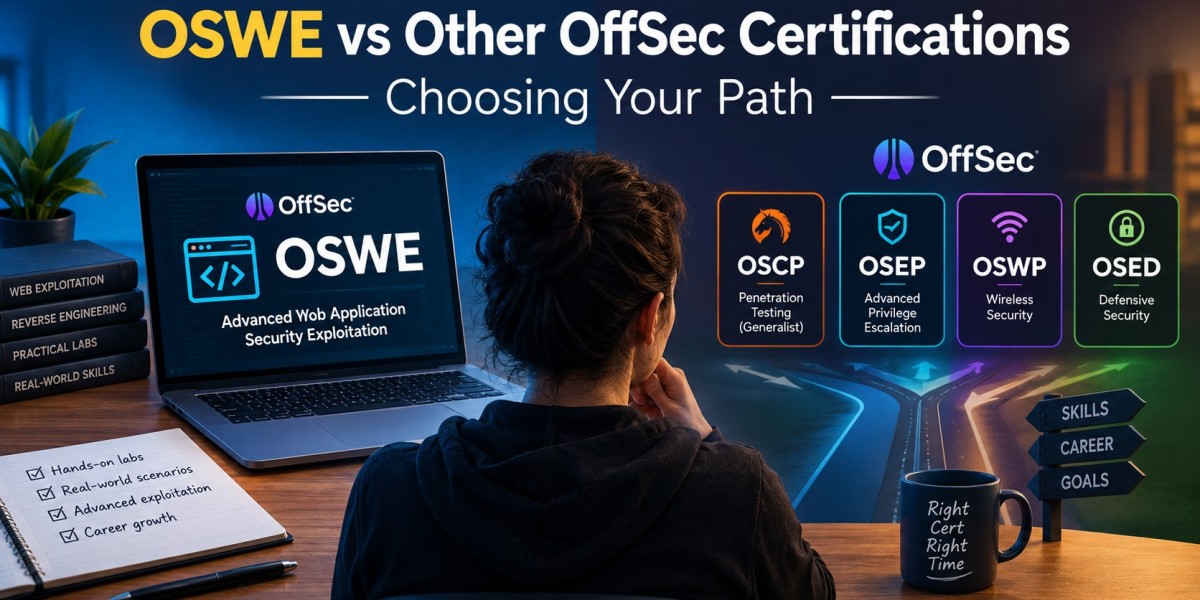

OSWE is OffSec whitebox web application specialization, testing source driven exploit development over a 48hour exam. It differs from OSCP (broad blackbox network and host penetration testing), OSWA (introductory web security) and OSEP (evasion and lateral movement) in both format and depth OSWE is the right choice for candidates who want deep, source code web application expertise specifically, rather than breadth across testing disciplines.
OffSecs certification path has grown wide enough that deciding what to pursue next is not always obvious. If you are weighing OSWE against OSCP, OSWA, or OSEP, the decision usually comes down to two questions what kind of security work do you actually want to specialize in, and are you ready for a fully whitebox, sourcecodedriven exam format rather than the blackbox style most other OffSec certifications use. This guide breaks down what OSWE actually tests, how it compares to the certifications candidates most often weigh it against, and how to map the syllabus to realworld skill.
What OSWE Actually Tests Exam Format, Syllabus and Topics
OSWE is built around a fundamentally different exam format than most OffSec certifications. Where OSCP and similar exams are blackbox you're given network access and an objective, with no source code OSWE hands you the complete application source code for each target and grades you on both your exploit chain and a professional written report documenting your process. The underlying WEB300 syllabus centers on a specific set of vulnerability classes authentication and authorization bypass, insecure deserialization (particularly Java and .NET), server side template injection, blind SQL injection, persistent XSS chained into further access, and fileupload or extensionfilter bypasses. A full breakdown of what to look for in a supporting OSWE preparation platform, specifically whitebox depth and exam realism, is worth reading once you've decided this is the certification you want, since it covers the evaluation criteria in more depth than fits here.
OSWE vs OSCP BlackBox Generalist vs WhiteBox Web Specialist
OSCP remains OffSec's foundational, most widely recognized certification, and it tests broad penetration testing competency across networks, hosts, and some web application vectors, entirely blackbox. OSWE, by contrast, narrows the scope dramatically to web applications specifically, but goes far deeper into that narrower scope by handing you full source access. Candidates typically pursue OSCP first, both because OffSec recommends it as a foundation and because the methodical, independent problem solving habits it builds transfer directly into OSWE preparation. Choose OSCP if you want broad, generalist penetration testing credibility; choose OSWE once you know web application security specifically is where you want to specialize deeply.
OSWE vs OSWA Depth vs Breadth in Web Security
OSWA sits earlier in OffSec's web security track, covering foundational web application security concepts at an introductory level, blackbox style. It's a reasonable stepping stone if you're newer to web security generally and want structured coverage of the basics before attempting something as demanding as OSWE. The relationship between the two is less "either/or" and more sequential OSWA can build foundational comfort with web application concepts, while OSWE tests a specific, advanced skill whitebox source review and exploit chaining that OSWA doesn't cover. Candidates already comfortable with web application fundamentals, whether from OSWA or equivalent experience, can generally move directly to OSWE preparation.
OSWE vs OSEP Web Exploitation vs Evasion and Lateral Movement
OSEP sits in a different part of the OffSec catalog entirely, focused on evasion techniques, lateral movement, and bypassing modern defenses in an Active Directorystyle environment, a very different skill set from source code web application exploitation. There's minimal overlap between the two, and the choice usually comes down to which specialization matches your career direction OSWE for candidates heading toward application security, secure code review, or webfocused offensive roles, and OSEP for candidates heading toward red team operations and defense evasion. Some practitioners eventually pursue both, since they represent genuinely different skill domains rather than competing options.
Who Should Choose OSWE as Their Certification Path
OSWE fits candidates who already know they want to specialize in application security, secure code review, or webfocused offensive testing specifically, and who are comfortable or willing to become comfortable reading source code across multiple languages under time pressure. It's a poor fit as a first certification for someone still building general penetration testing fundamentals, and it is a poor fit for candidates whose career direction leans toward network level or red team style work rather than application layer depth. If you're unsure which direction fits, comparing your daytoday interest to reading and understanding code, or to network level and infrastructure attack paths is a more reliable signal than certification popularity alone. Talking to practitioners already working in the role you're targeting, and asking specifically which certification they use day to day rather than which one they simply hold, often surfaces a clearer answer than any generic comparison can.
Mapping the OSWE Syllabus to RealWorld Skills
Every OSWE syllabus topic maps to a skill that's directly useful in application security work outside the exam itself, which is part of what makes it worth pursuing beyond the credential. Manual source code review the core skill practiced through resources like a dedicated source code review lab is directly transferable to secure code review roles and internal security assessments. Blind SQL injection technique, practiced against a realistic SQL injection lab, remains relevant well beyond the exam since inference based extraction shows up in realworld assessments long after specific tooling changes.
Tooling You will Rely On for OSWEStyle Work
Even in a fundamentally whitebox exam, you'll spend meaningful time interacting with live applications to confirm what you've found by reading code which means fluency with Burp Suite for intercepting and manipulating requests remains a practical necessity, not just a blackbox testing skill you leave behind once you move toward source driven work.
Building Practical Experience Alongside Certification Study
Certification study benefits from realworld reinforcement. Full application web hacking labs that present complete, realistic targets give you exam adjacent practice outside formal coursework, and independent experience through bug bounty hunting builds the self directed assessment instincts that transfer well to any of these certifications, OSWE included, since bug bounty work rarely comes with a defined syllabus either.
How Career Direction Should Actually Drive the Decision
It's worth separating certification popularity from certification fit. OSCP carries the broadest name recognition and is often treated as a default next step, which is reasonable given how directly it supports general penetration testing roles. But recognition alone shouldn't drive the choice between OSWE, OSWA, and OSEP once you're past that foundational stage, because each represents a genuinely different daytoday skill set. Application security engineers and secure code reviewers get more direct career value from OSWE's sourcecodedriven focus than from OSEP's evasion techniques, while red team operators see the opposite. If you're not yet sure which direction fits, look at the parts of security work you gravitate toward outside of formal study engineers who enjoy digging through an unfamiliar codebase tend to find OSWE preparation intrinsically engaging rather than purely credentialdriven, and that engagement tends to predict better exam outcomes than certification prestige alone.
Timeline Expectations Across the Three Paths
Timelines vary meaningfully by certification, partly because of exam format and partly because of typical candidate starting points. OSCP candidates often spend two to four months in dedicated preparation, reflecting its position as many candidates' first serious offensive security certification. OSWA, as an introductory webfocused credential, typically requires a shorter runway for candidates who already have some general security background. OSWE, given its narrower but deeper syllabus and the specific, less commonly practiced skill of source code review under time pressure, tends to run three to six months for most candidates even after OSCP, precisely because whitebox work doesn't automatically follow from prior blackbox experience. OSEP timelines vary widely depending on prior exposure to Active Directory environments and evasion techniques specifically. None of these numbers are fixed, but they're useful for setting realistic expectations rather than assuming certifications scale in difficulty and time investment uniformly.
Common Gaps Candidates Underestimate When Choosing OSWE
Candidates moving from OSCP or OSWA toward OSWE often underestimate how different whitebox work actually feels in practice, even when they intellectually understand the format difference going in. The specific gap is usually reading speed and confidence in an unfamiliar codebase, a skill that doesn't automatically follow from blackbox testing experience, however extensive. This gap shows up consistently in the broader landscape of application security challenges developers and testers face, where the difference between spotting a vulnerability pattern in isolation and tracing it through a real, multifile application is often the actual bottleneck.
Where Solid Fundamentals Come From
Regardless of which certification path you choose, the fundamentals underneath all of them are the same careful, methodical testing habits and clear documentation. General guidance on web security best practices and rigorous web application security testing methodology apply whether you're pursuing OSCP, OSWA, OSWE, or OSEP the certification specific skills sit on top of that same foundation.
Stacking Certifications Over a MultiYear Career Path
Few practitioners stop at one certification, and it's worth thinking about OSWE's place in a longer sequence rather than an isolated decision. A common trajectory looks like OSCP first for broad credibility and foundational habits, then a branch point engineers heading toward application security add OSWE, sometimes preceded by OSWA if they want an intermediate step, while engineers heading toward red team work add OSEP and often further offensive certifications beyond it. Some practitioners eventually pursue both branches, since application security depth and red team style evasion skills are complementary rather than redundant on a resume but doing so is a multiyear investment, and it's more realistic to plan one branch at a time based on where your next role or promotion actually depends on new skill, rather than collecting certifications for their own sake.
Conclusion
Choosing between OSWE and OffSec's other certifications comes down to matching exam format and depth to your actual career direction OSCP for broad generalist credibility, OSWA as an optional foundational step in web security, OSWE for deep, source driven web application specialization, and OSEP for a genuinely different evasionandlateralmovement track. None of these paths is objectively better ; the right one is whichever matches the specific skill you want to build next. Explore current practice tracks on the AppSecMaster homepage if OSWE's whitebox, sourcecodedriven format is the direction you've settled on.
Frequently Asked Questions (FAQs)
Is OSWE harder than OSCP?
They are difficult in different ways rather than directly comparable on a single scale. OSCP tests breadth across blackbox testing scenarios over a shorter exam window; OSWE tests deep, source code driven exploit development over a 48hour whitebox exam plus a graded report. Most candidates who've done both describe OSWE as demanding a more specific, narrower skill practiced to a higher degree of fluency.
Can I skip OSCP and go straight to OSWE?
It's possible, but not commonly recommended. OffSec doesn't formally require OSCP first, but the methodical, independent testing habits it builds are assumed in OSWE's format, and skipping straight to OSWE without that foundation typically means building two skill sets simultaneously instead of one.
Do OSWA and OSWE overlap enough that I don't need both?
They overlap conceptually and both fall under OffSec's web security track but OSWA is an introductory, blackboxstyle credential while OSWE tests a much deeper, whiteboxspecific skill. Candidates already comfortable with web fundamentals from other experience can often skip OSWA and move directly to OSWE preparation.
Should I pursue OSEP if I already have OSWE?
Only if your career direction is heading toward red team operations and defense evasion specifically. OSEP and OSWE test genuinely different skill domains evasion and lateral movement versus source driven web exploitation so having one doesn't meaningfully prepare you for the other, and pursuing both only makes sense if both skill sets serve your actual goals.
How do I decide if OSWE is right for me if I'm still early in my career?
Look at what kind of work energizes you day to day. If you find yourself drawn to reading and understanding code, secure code review, or application layer vulnerabilities specifically, OSWE is a strong long term target even if you need to build foundational testing experience first. If network level and infrastructure work interests you more, OSCP or OSEP likely fit better.